Saturday, April 01, 2006

Apple II Forever

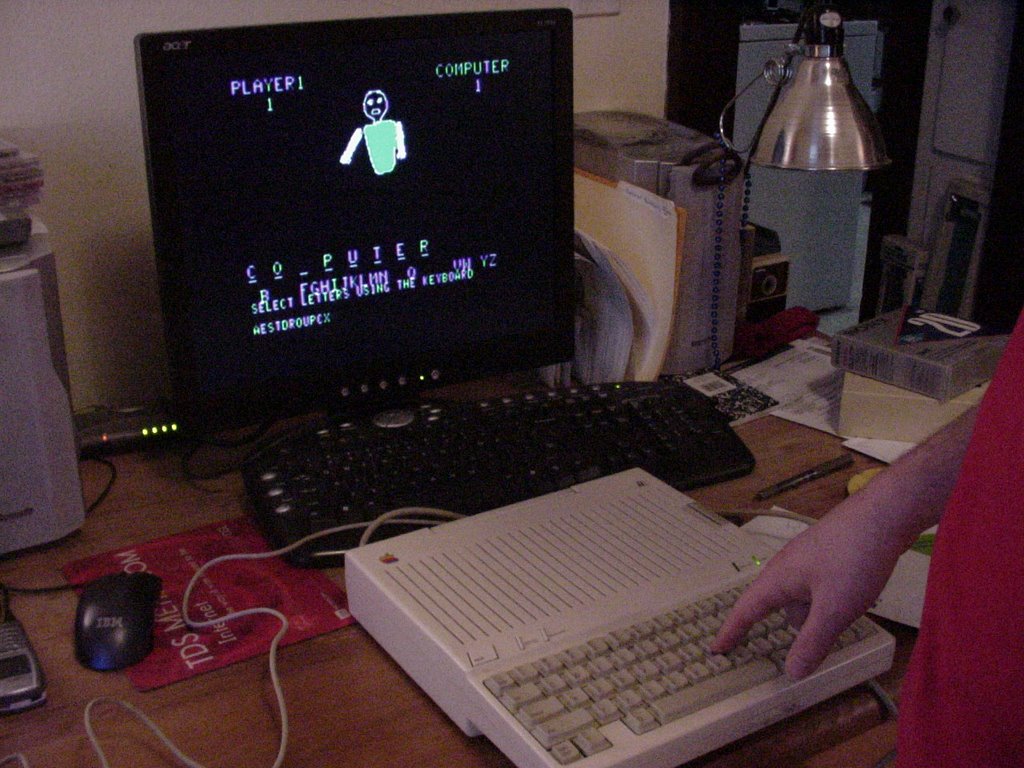
Today is the 30th anniversary of Apple Computer, Inc., and to mark the occasion I cranked up my old Apple II -- more precisely, my Apple IIc. A successor to the original Apple II computer, which was released in 1977, the IIc came out in 1984. It cost $1,295 and came with a single 5 1/4" floppy disk drive, 128 kilobytes of RAM, and a cable that connected the computer to a television. A color monitor was $200 extra.

The IIc was meant to extend the life of the venerable Apple II technology, which had made the company's fortune. But there was something new with the IIc: unlike the original Apple II, the IIc came in a case that was sealed at the factory, and owners could not easily open it to install extra memory, expansion cards and so forth. The openness of the original Apple II's design was partly what made it so popular (especially with hobbyists and tinkerers), and IBM incorporated a similar openness into the design of its original PC -- which is why, to this day, it is still easy to pop open the case of just about any desktop Windows computer and install network cards, sound cards and so forth.

My recollection is that Apple cofounder Steve Jobs had always been uncomfortable with the openness of the Apple II. That is why Apple's Macintosh computers came in factory-sealed cases from the very beginning -- the original Mac also came out in 1984 -- and why, I suspect, the IIc did as well.

My IIc used to belong to my great aunt Edith, who I believe picked it up at a church bazaar. She gave it to my family, and it sat in a Nashville attic for about 15 years before I brought it to Wisconsin. If you know what Nashville attics are like in summer, you'll be as surprised as I was to learn that the old contraption still works just fine. That speaks well for Apple engineering.

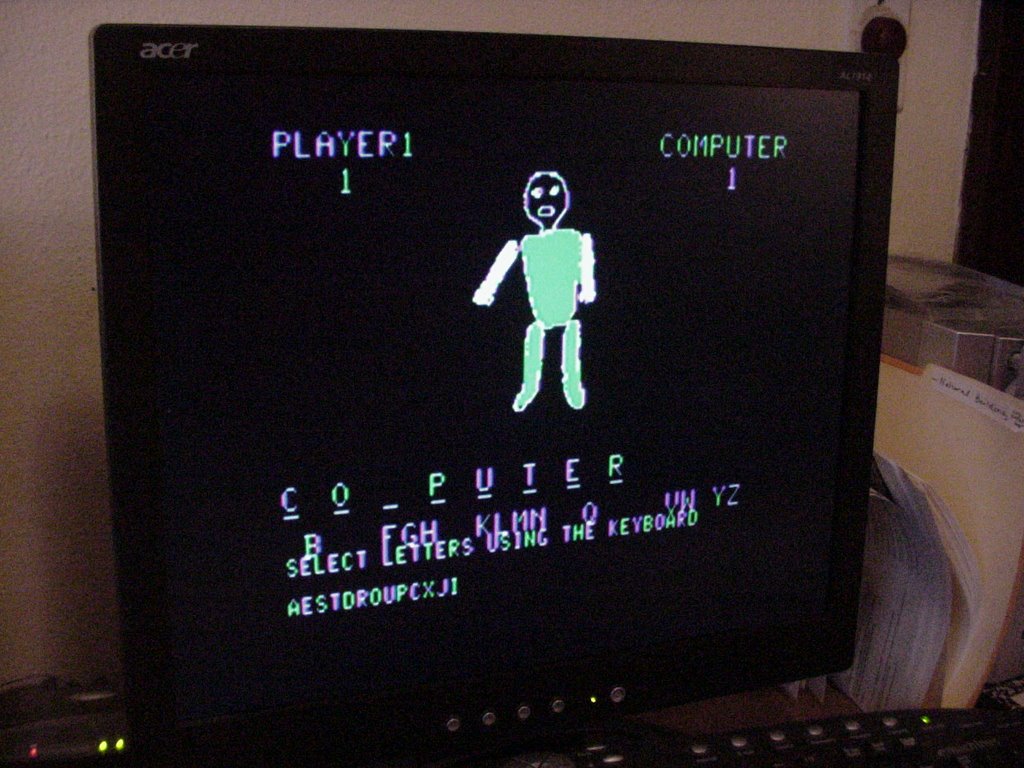
Here are some pictures. I'm not sure what compels me to hook this thing up every now and then, but as Ereck demonstrates, it remains good for playing hangman.


Wednesday, March 29, 2006

Gig alert

You oughta know that on Sunday, April 2, I'll be performing a solo set at the Harmony Bar, 2201 Atwood Ave., as part of a benefit for Neighborhood Connections, which provides residential support to people with developmental disabilities.

Also appearing are the wonderful Cash Box Kings, Bruce Bollerud and George Gilbertson of the Goose Island Ramblers, and many others.

Showtime is 3 pm, and the cost is $10. More details here.
Question for longtime Madisonians

Why is the Willy Street Pub known familiarly as the Wisco?

Tuesday, March 28, 2006

So long, Buckaroo

I applaud the fond farewells to country legend Buck Owens, who died Saturday, except for one thing: Some are unironically citing "Hee Haw" as one of his great achievements. This upends somewhat the conventional wisdom, which is that it's a shame Owens will be remembered largely for "Hee Haw," and not for the pioneering Bakersfield country music he wrote and performed in the 1960s.

I happen to agree with the conventional wisdom. I can't deny that "Hee Haw" has its pleasures, but it was, let's face it, mediocre television at best. The music may have been good, often, thanks to Owens, but the show mostly dealt in unfortunate stereotypes of Southerners. Of course, unlike contemporary TV shows that did the same thing ("The Beverly Hillbillies," "Petticoat Junction"), at least "Hee Haw" was produced in the South by Southerners. But I'm not sure how mitigating that is. (When I was a kid in Nashville, I once went to a taping of "Hee Haw.")

Over the weekend, I watched as various news programs reported Owens' death. And the video clip I saw, over and over, was of him and "Hee Haw" co-host Roy Clark making bug eyes and exclaiming, "I'm a-pickin'!" "And I'm a-grinnin'!" Around them Nashville actors in overalls and straw hats bounced up and down. The performance seems undignified, unlike other video I saw this weekend of Owens from the 1960s, when he strummed a Telecaster and sang "Act Naturally."

I'm not sure how "Hee Haw" could have presented a more dignified image of the South, though. Readings by Robert Penn Warren?

All this brings to mind something Pauline Kael wrote about Alan Alda: "There is a price to be paid for being likable in a TV series week after week, year after year." Owens was goofy on "Hee Haw," week after week, year after year, and that has a way of obliterating our recollection of, for example, the tragic urgency of his 1965 hit "Cryin' Time," all two minutes and 29 seconds of it.

The paradox, of course, is that "Hee Haw" may be the only reason Owens is being hailed so widely at all. This is the power of the moving image: It makes personalities linger. And this is why we tend, collectively, not to remember famous stage actors like Alfred Lunt and Lynn Fontanne. Stage performances do not linger.

Seen in this light, Owens reminds me of Agnes Moorehead, who is instantly recognizable to several generations of Americans as Endora, the mother of Elizabeth Montgomery on "Bewitched." Moorehead took the role at age 64, decades after the crucial performances she did as part of Orson Welles' Mercury Theatre ensemble, on stage and radio, and in films. But it's Endora we remember.

That's not altogether a bad thing. Endora is one of the most indelible characters in television, and that surely is thanks to Moorehead's craft. And so at least everyone knows who Agnes Moorehead is, even if not for all the best reasons.

And likewise, everyone knows who Buck Owens is, perhaps thanks mostly to "Hee Haw." As well they should.

Sunday, March 26, 2006

Out and about

In the current Isthmus is the latest installment of my Nightlife column, wherein I report my impressions of roller derby, folk-music house concerts and the Palace Latin Club.

Saturday, March 25, 2006

I didn't order that

New York Times
technology writer David Pogue blogs about software applications that start themselves unbidden when the Windows computer they're on is booted. This phenomenon bugs me no end, and I regularly use the msconfig utility to turn off these startup programs, which run invisibly and needlessly use up system resources. To do that, I click Start, then Run, type msconfig, and click OK. The startup applications are on, yes, the Startup tab.

Looking at my msconfig list, I see that my computer hosts startup applications for many mainstream programs, including Acrobat, AIM, TiVo Desktop, QuickTime, iTunes and the Microsoft programs Money and Works. There also are startup apps for various hardware devices I have installed, printers and external hard drives and network adapters and so forth. I turn 'em all off, and my computer runs faster.

There also are startup apps for many programs I don't recognize. I suspect various Web sites I visit have installed some of these without my knowledge, which is truly scary.

This is crazy. As I've noted before, what I know about designing operating systems I could fit in my little fingernail, but it seems to me fairly basic and urgent that OSes shouldn't let unknown programs install themselves willy nilly. And that consumers should be able to choose whether they'd like for memory-hogging programs they don't use to start themselves.

Friday, March 24, 2006

What's that device

Every Sunday the Wisconsin State Journal runs a puzzling column called Listen Up, in which lyrics to the popular hits of the day are printed. "Though some of the language might be objectionable to some readers," reads an introduction, "we hope it will provide parents with a better idea of what their children are hearing."

A recent installment ran the lyrics to Daniel Powter's "Bad Day," so parents could know their children were being exposed to potentially objectionable language like this:
Where is the moment we needed the most
You kick up the leaves and the magic is lost
They tell me your blue skies fade to grey
They tell me your passion's gone away
Inspired by Listen Up, I'm instituting a new feature on Back With Interest called What's That Device. In it, I will use lyrics from the popular hits of the day to show the usage of certain invaluable rhetorical devices. I'm inaugurating What's That Device with this line from Black Eyed Peas' infectious, zeitgeist-defining, cheerfully objectionable smash hit "My Humps":
Let's spend time, not money
This is an example of zeugma, which Richard Lanham's indispensable Handlist of Rhetorical Terms defines as "A kind of ellipsis in which one word, usually a verb, governs several congruent words or clauses." So the Black Eyed Peas' lyric uses the verb spend once, but in a double sense, so that it applies to both time and money.

Here's another example, from Alexander Pope's The Rape of the Lock (emphasis added):
Whether the Nymph shall break Diana's Law,
Or some frail China Jar receive a Flaw,
Or stain her Honour, or her new Brocade